Blog
< Back
Burkina Keeps Bringing up the Rear…
The United Nations’ Development Project just published its annual report on the Human Development Index (HDI). Burkina Faso ranks 185th of the 188 countries in the table, ahead only of Chad, Niger and the Central African Republic. Fourth from last…In 2014 Burkina Faso was the 182nd country of 187 and in 2015, it was number 183 of 188. In three years, we’ve moved from seventh from last to fourth from last. The tragedy isn’t so much being at the end of the list as it is not advancing – falling ever further behind.
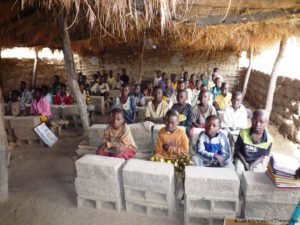
Access to EDUCATION: classroom under roof of straw with concrete blocks used as desks…
The HDI is an index (http://hdr.undp.org/en/countries/profiles/BFA) that attempts to evaluate and rank human development in almost all the world’s countries, based on indicators like life expectancy (59 in Burkina), years of schooling (1.4 years on average), and the Gross National Product (some $1,400 per capita). Some dozen indicators try to reflect inequality, the status of women, the concentration of power, employment, the homicide rate, etc.
All this gives Burkina an index of 0.40 on a maximum of 1.0. For comparative purposes, in 2015, Norway – number one for years – had an index of .95; the USA, in tenth place, had a .92; Spain had a .88 at number 27; all the way down to Kuwait, at number 50 with an index of .80, closing out the list of “very high HDI.” The list of “high HDI” ends at number 106, which is Uzbekistan with an index of .70. Then comes the list of the 40 countries designated as “medium HDI,” which is closed out by Pakistan at number 147 with an index of .55. The final 41 countries, designated as “low HDI” ends with the Central African Republic at number 187 and an index of just .35
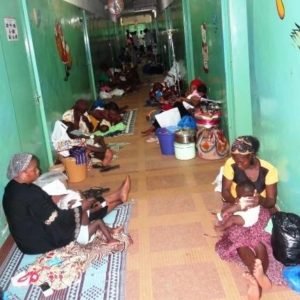
Access to HEALTH: urgencies’ corridor of the pediatrics’ Ouagadougou’s public hospital
Notwithstanding that any ranking system can be disputed (though the UN’s HDI rankings are less debatable because they use a methodology that has been fine tuned over decades), the importance of what we are doing together through our modest FAR is clear. Our Rimkieta neighborhood (45 sq kms with 90,000 inhabitants) today enjoys something that our neighboring area of Zongo lacks, remaining 10 or 12 years behind. FAR is a not for profit organization that attends to thousands of people based on the sense of solidarity and generosity of some thousand other people – almost all of whom live in Spain. Perhaps without what we’ve done together, Burkina would be even worse off by these short-term measures. But I have no doubt that Rimkieta would be much the worse without the source of human and social development that FAR tries to be. It’s a shame not to be able to do more… But remember, FAR doesn’t want to grow into something large because its goal is to persevere and remain, which requires great prudence and measured action to insure its continuity.
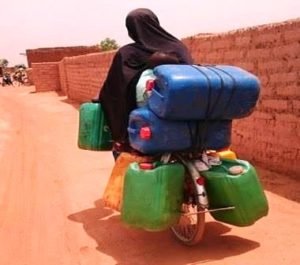
Access to WATER: 28 % of the population does not have access to water and the great majority of those who have access to it, lives more than 30 minutes afoot of the nearest source.
Despite the not very inspiring numbers, – as it seems to advance more slowly than others -Burkina Faso does undoubtedly advance. And what’s important is realism; we – the few hundred Friends of Rimkieta – aren’t going to fix Africa, nor Burkina, nor Ouagadougou, nor even our own Rimkieta neighborhood. But we have planted a seed of hope and progress, of cultural and social change. Over the course of 13 years FAR has prepared and provided to some fifty staff members and another 30 free-lance professionals a great opportunity to live with earnings well above the country’s average, with a good working climate, security and training. We are taking direct care of 1,300 woman and children, and we improve, indirectly in one way or another, the lives of some 12,000 -15,000 (it’s hard to calculate) human beings in one of the least fortunate corners of the world – with the certainty that what we do every day matters, and whatever will be, will be, if we persevere. It is hard and tiring work… but it is worth it. It’s impossible to evaluate, and difficult to appreciate from here. But just ask those proud and grateful people who live the FAR there and are the envy of their neighbors.
Let’s keep it up; it’s worth it. And thanks again to everyone, on behalf of all of us.