
Blog
< Back
France 0 – Russia 1 (Wagner Arrives in Burkina)
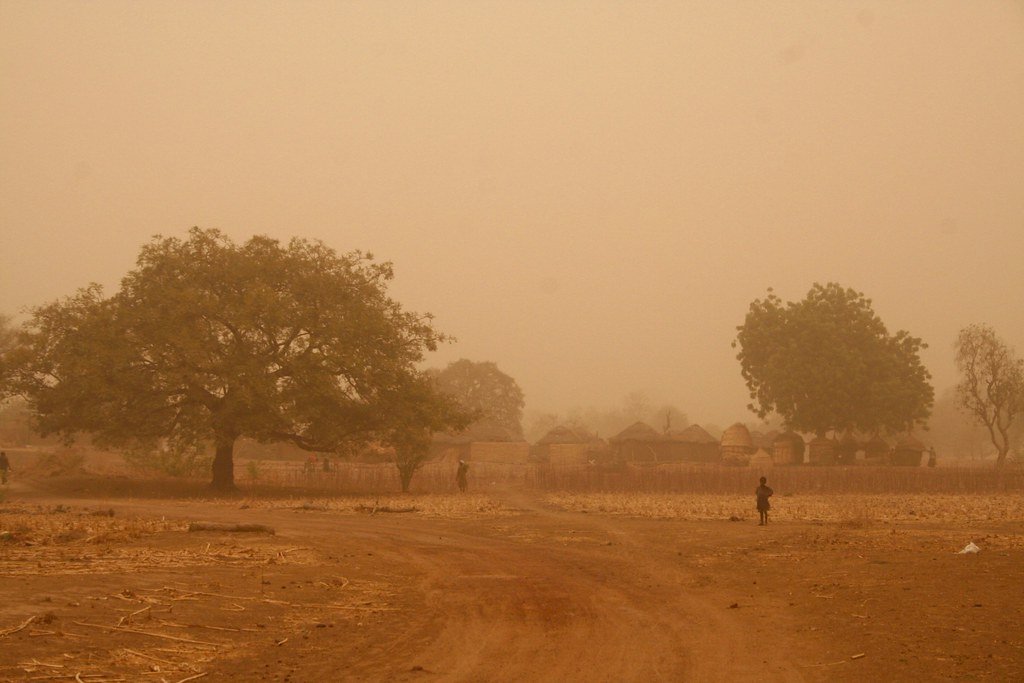
Atmosphere during harmattan. Photo: Jean Michel Flickr
What might appear to be a wager on the outcome of a 2026 FIFA World Cup qualifying match (assuming that Russia is readmitted after having been expelled from the Qatar World Cup for invading Ukraine) is actually a metaphor for Russia’s potential victory over France in the fight for first place in ‘bilateral’ cooperation with Burkina Faso and other Sahel countries.
The month of January is very ‘sweet’ in Ouaga, with nights at 15º and days no hotter than 35º. Nevertheless, as perfection is elusive, these comfortable temperatures coincide with the harmattan, a dry wind from the Sahara that blows towards the Gulf of Guinea, raising sand and dust in its path. This year, the trade winds were accompanied by ‘changing winds’ in Burkina Faso’s alliances with new allied countries.
Everything started in the most recent coup d’état of October 2022. As I recounted in the post “Back to square one (10th coup d’état in Burkina)“, Captain Ibrahim Traoré took power, undertaking the same path of ‘anti-French politics‘ initiated in 2021 in neighboring Mali, a former French colony facing jihadist challenges like Burkina’s.
Since then, the Burkinabé government has carried out several actions confirming its desire to sever relations with France. These actions have been accompanied by repeated pro-Russia/anti-France popular demonstrations – over social media, and through ‘meetings’ and mobilizations of the population, not all of which have been peaceful.
The government’s first move was to suspend the broadcasting agreement with RFI (Radio France International) based on an accusation of “non-compliance and propensity of the media to discredit the fight against terrorism.“
Subsequently, the new government formally asked France to dismiss its current ambassador, claiming that he was no longer “a reliable interlocutor” for Burkina.
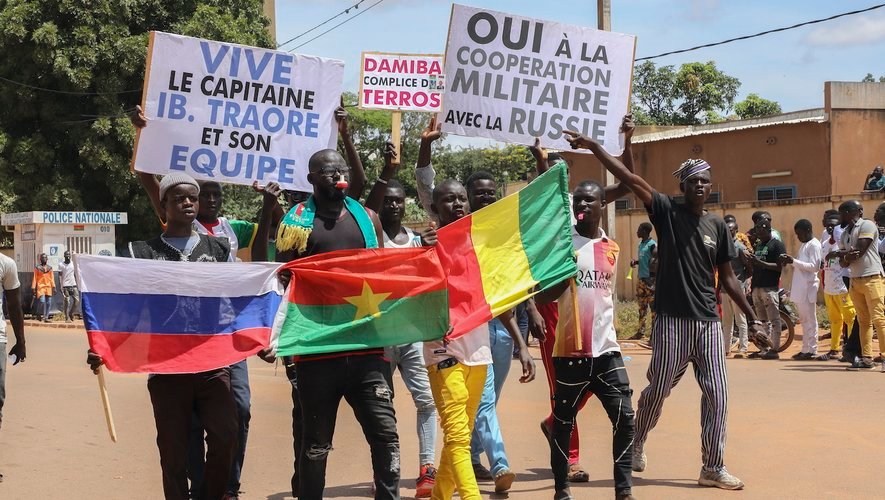
Pro-Russia and anti-France demonstration in Ouaga. Photo: EPA Assane Ouedraogo
French presence is not the only one being minimized. The day before Christmas Eve, the UN Resident Coordinator in Burkina was declared “persona non grata” after serious accusations of possible collaboration with terrorists, and ‘invited’ to permanently leave the country within 24 hours.
The icing on the cake came just a few days ago with the announcement of the end of the agreement on the presence of French military forces in the country. France was given one month to withdraw the 400 Special Forces that are part of Operation Sable. Another neighboring country, Niger, which already has the help of nearly 2,000 French troops, is likely to be its new destination.
Burkina justified this move by declaring that “the vision of the transitional government is that the Burkinabé themselves be those who sacrifice for the country’s freedom.” To this end, the government undertook a massive recruitment of 3,000 soldiers to reinforce the army and 50,000 new VDPs (Volunteers for the Defense of the Fatherland) to add to the unknown number of VDPs that have been operating since 2019.
The VDP is a self-defense militia, formed by Burkinabé civilian volunteers (farmers, artisans, small merchants …) whose objective is to save their families from a highly probable massacre (giving them enormous motivation for the struggle). They come mostly from the areas targeted by jihadist attacks, so they know the terrain very well. After only two weeks of training, they are armed. Since its creation in 2019, more than 500 VDPs have died.
A group of VDPs. Photo: © Archives Faso7
While the VDP’s intentions are highly commendable and they have had several successes in their fight, it is also true that their actions have led to allegations of ethnic attacks, reprisals and other abuses, which, for the moment, appear to remain investigated. These ethnic attacks and reprisals stem from the belief that the Peul ethnic group, the largest in West Africa (whose indigenous name is Fulani), supports and collaborates with terrorists.
Yet the massive recruitment of soldiers and VDPs will not be enough, and after successive meetings, both in Burkina and in Russia, everything indicates that the departure of the French military was the necessary step to allowing the entry of the civilian paramilitary group known as Wagner.
Without delving into France’s historical relationship with its former colonies, the fact that many of them occupy the top positions on the list of underdeveloped countries with terrorist problems is an objective indicator that something has not been done right.
Although the desire for full independence is legitimate – and something I would love to witness one day regardless of how badly France has performed in the past – the deterioration of the situation is by no means solely France’s fault. I am afraid that reaching out to Russia (= Wagner) will mean ‘more of the same’ … if not worse.
Everything that is held against France (mainly its exploitation of the country and its resources, as well as its condescending attitude and management oriented exclusively to its own interests) will also come from Wagner’s hand. Yet this private paramilitary group will add to the existing grievances, as it is known to operate with total impunity in the methods it employs to fight terrorism or any other cause (infinitely worse than the accusations against the VDP). This is only natural, as the origins and motivations of a country’s military and its community volunteers are nothing like those of the ‘warriors’ (“people for whom war is a way of life“), many of whom come from Russian prisons.
 The benefit of being towed is the ability it affords to learn from the mistakes of those ahead. It seems that Burkina – unlike Mali, which may be trapped in ‘Russian nets’ – does not want to play ‘exclusively’ with Russia. Both Captain Traoré and his prime minister have stated that they are open to collaborating with “the United States or any country willing to help them defeat the jihadists.” Nevertheless, I fear that any coexistence between cooperation with Russia and with any other country in the West is not compatible. The future will tell.
While it is true that the outlook may not seem encouraging, it also seems to me that these many drawbacks are unlikely to have a major impact on what I think of as “the microcosm of FAR in Rimkieta.” I am convinced that we will continue working here for a long time.
I can say this because – to continue the soccer analogy – I think that the ‘political intrigues’ of Burkina-Russia-France-European Union-United States are like the Champions League, while the FAR is more like the 5th regional division (with all due respect to the 5th regional). We aspire to continue in our division, working with the same enthusiasm, rigor and austerity as if we were in the Champions League, yet, with the low profile of the 5th. Furthermore, I don’t think the Champions League ever bothers to look at the 5th regional division.
Therefore, everyone should remain calm. Because with or without French troops, with or without Wagner groups, the FAR still has a lot to give here, with the help, affection and support that we know we can count on from you.
Happy New Year!