“And You, What Makes You Happy?” This is the question we asked each of the twenty girls in this fourth year of the unschooled girls project during the monthly personal chat in March. What do you think their answers were?
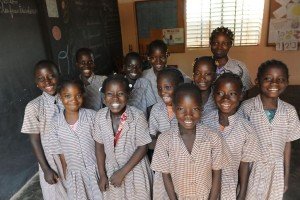
Girls from the 4th promotion. It so easy to make them happy!
“I’ll be happy the day they buy me a bicycle” (Aminata, 10 years old)
“I’m happy if they make me a flowered dress” (Marie, 9 years old)
“Presents wrapped in pretty paper make me happy” (Alimata, 8 years old)
These three answers from Aminata, Marie and Alimata could be the same as answers from “Dolores, Antonia and Pepita” They sound more or less what would be expected at this age.
But we also got some answers a lot more in line with the daily life of boys and girls in Rimkieta – a reality far removed from the Western one:
“I’m happy when I can eat three times a day” (Collete, 8 years old, and Larissa, 11)
“What makes me happy is to eat salad once in a while” (Bintou, 8)
“When I get to play with a doll for a while I’m happy” (Saibata, 8)
“What makes me happy is to be in school and have the material I need to study.” (Julienne, 10)
“To be the first in class and be given a notebook to do my homework in makes me happy” (Latifatou, 9)
The majority of these responses are on another plane. They fall within the realm of such basic needs that they would never occur to us as possible answers in our society.
And no less surprising were the answers to the question “What makes you sad?”
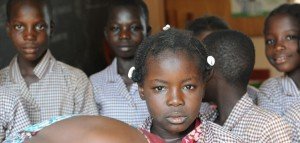
“Hunger makes me sad”…
“Hunger makes me sad” (Marie, 9 years old)
“”When my grandmother can’t afford to buy breakfast I am sad” (Bintou, 8 years old)
“When I think my Grandpa is dead and my mother isn’t with me I am sad” (Latifatou, 9 years old)
“I’m sad when someone in my family dies” (Colette, 8)
“I’m sad when I get bad grades” (Asseta, 9; Fatoumata, 8; Adeline, 9 and Julienne, 10)
“I’m sad when I get sick” (Sabita, 8)
“It makes me sad when my grandma is sick” (Nemata, 10)
“I get sad when they hit me at home” (10 out of 20 girls gave this answer)
These answers leave us speechless… all of them. Those of you who read February’s post “Corporal Punishment as a Means of Education” won’t be surprised that 10 of 20 answers have to do with being beaten at home.
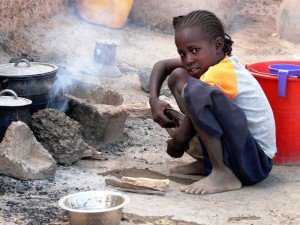
Obey at home and do the chores that are asked of me, secret to hapiness
But desperate times call for desperate measures. So each of them has her own tricks to ward off sadness. To the question “What do you do about it when you are sad?” The majority responded “Work well at school, obey at home and do the chores that are asked of me so they don’t get mad at me and hit me”
Through the personal chats with the girls, as well as by asking them their opinions about things and giving them the opportunity to express themselves – something no one ever does – we hope to get to know them a bit better and to use their responses to try to transform – little by little and always respecting the local culture and tradition – the living conditions of the boys and girls of Rimkieta.
And we are here, as you know, to “keep up more than to take up.” With no expiration date and with renewed energy every day, thanks to the help of groups like the Foundation Women for Africa, which has been subsidizing this project for girls since 2013. What you can see in the following video is not staged… The girls are that joyful despite their tragedies. Food for thought…
Link: The 4th promotion says “Thanks to Mujeres por Africa“!