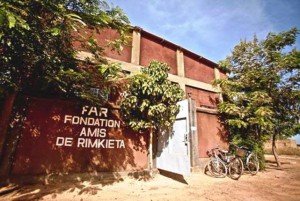
FAR’s entrance in Rimkieta
This is my recount of my latest trip. It seems to me it merits the title “Burkina is saved!” Because among so many good things we saw, the most important is that Burkina Faso can serve as an example to the world of how an oppressed nation is capable of rebelling and resolving its situation with a minimum cost of life and property.
The solution: the general elections that all interested parties are diligently preparing for next October 11. May the Virgin of Peace guide and protect them!
Saturday, February 28
I begin the account of the February 28- March 5 trip to Rimkieta, delighted to be joined by a group of 6 daring friends who’ve signed up this time. Fernando, who is a Patron and is talking the trip for the fourth time – this time with his good friend Javier – left Barcelona yesterday.
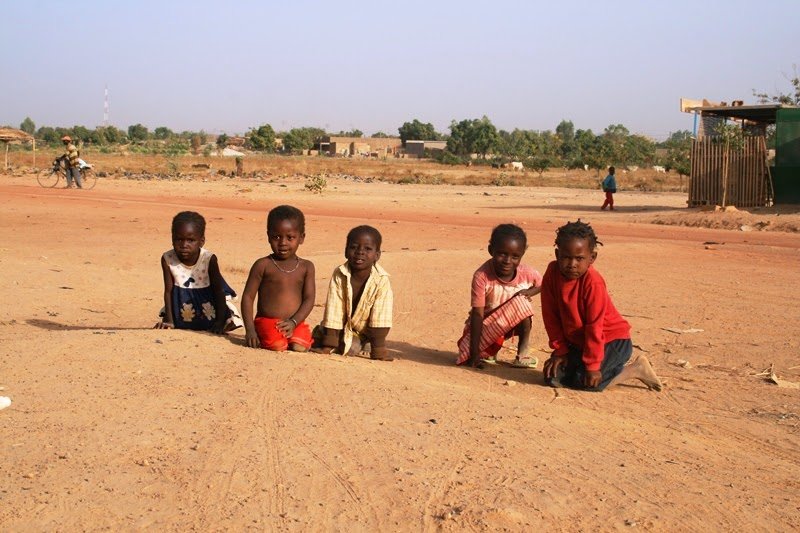
Rimkieta’s children
As is not uncommon, they arrived without luggage, which showed up four days later. Uaga is a dangerous destination for baggage. Today, Eva, Carme and I set off from Barcelona; Chus from Madrid; and Valéry from Switzerland. We met in Paris and continued together to Burkina, where my son-in-law Patrick met us. His help in the airport is indispensable. He makes everything go smoothly despite the overcrowding (at 10 pm because of a plane full of Pan African Cinema Festival-goers) that made everything especially difficult…At the hotel, we got to our rooms and went straight to bed to wake up bright and early tomorrow to attend a large Mass in the Saint Paul Chapel. His Eminence Archbishop Philippe Ouedraogo will celebrate the Mass at 8 a.m. The weather is predicted to be good, between 25-35 degrees, though windy.
The trip was pleasant. We discussed the week’s schedule, especially the “maternidad” project, which is a primary objective. The new Maternidad aims to help improve the negligible conditions in which children are brought into the world in Rimkieta and the minimal medical attention that their mothers receive. We
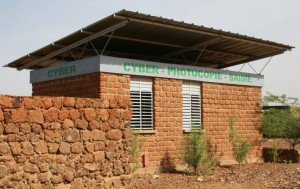
FAR’s Cyber
talked, too, about plans to overhaul the Cyber in order to assure its sustainability. In the end, a “Cyber-office” is not a service of primary necessity for the great majority of inhabitants of an area as poor as Rimkieta, although it does make life easier for a few hundred of them… We are going to look into it seriously with Chus’ help. She’s already working on it and has offered to prepare a sustainability plan. Another great collaborator, Jorge – a techie – is also planning a trip here. He will devote his Holy Week vacation to our Foundation in order to review everything related to IT and communications, both at the Maternelle and the Cyber, as well as connecting María’s house, where the access to the web is quite poor. Things are like that there – Christina’s house has access to the web, but not María’s house…
Sunday, March 1
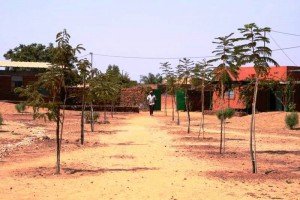
CCB’s “placita”
Up at 6 a.m., as Mass is scheduled for 8, and there are ¾ of an hour between the hotel and the CBC (Christian Base Community) “plaza” where the Saint Paul chapel is.
The “plaza” is an area marked off by a wall a half-meter high that FAR built two years ago in order to provide the population with an area to get together to hang out with places to sit under the shade of acacias and other trees.. The plaza is home to the Luis well, the cereal bank, the mill and the cyber – four of the projects under way. This year, we’ve plastered and painted the Saint Paul chapel walls, which were in bad shape.
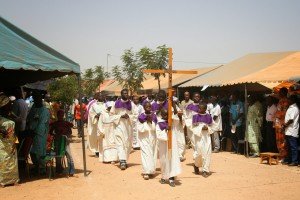
Cross’ procession during the Mass at the CCB
Between two and three thousand people attended the Mass, which was officiated by his Eminence, the Auxiliary Bishop of the Archbishop Cardenal, Leopoldo Ouedragó. Our parish priest, Father Joseph, also participated, along with other priests. (At the end of this account you will find a prayer for Burkina written by Father Joseph and other priests. A plasticized copy has been hanging in the Maternelle’s entrance for two or three years). The choir and the townspeople sang so many songs. The bishop gave a long homily and the event finished with an hour of speeches by the various religious and civil associations. One of them invited me to come up to hug his Eminence the parish priest, as “María’s dad.” There was warm applause for the Foundation, recognition for all the work over these years.
A long lunch at the hotel to make up for the breakfast we couldn’t eat because service started a half an hour later than promised. The tables weren’t even set, nor the buffet set up. The bread hadn’t even arrived…We grabbed a bite and ran off so as not to arrive late to Mass, which also started late….
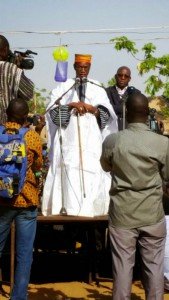
Larlé Naaba Tigre’s speech
In the afternoon, we attended a party for the XXV anniversary of Larlè Tigré Naaba’s appointment. As always, he honoured us with repeated mentions in front of the thousands of people there to wish him well. As a sponsor of art and culture, in general, the party was a loud manifestation of songs, dances, horses…There were speeches – mostly in Moré, the language of Burkina’s ethnic majority the Moosi – by the Naaba himself and by representative authorities from all the social strata, and very specially from the Gran Mooro Naaba, the chief. Larlé Tigré Naaba’s figure was thoroughly examined for his dedication to his people, his dedication to the arts, his great capacity for work and his entrepreneurship that has created tens of thousands of Jobs. As he himself said, “I have no right to rest on my laurels, because my job is to care for and protect the people who trust me.”
Our lawyer, Maitre Fulgence, is a true professional who was born in Rwanda but established himself in Uaga some years ago. Fulgence is a trusted aide to Maitre Keré, a stellar figure within and outside Burkina who was the dean of the bar association, negotiator between the deposed former president and the civil forces. He is currently in charge of rebuilding the national census of voters expected for October 2015. Both men’s generosity with the FAR, from the very beginning, is in my opinion strong proof that the name the assassinated president Sankara chose for his country (Burkina Faso in Moré and Diula “the land of men of integrity”) was appropriate. Every country has all kinds. But in any case some trait or another stands out as being characteristic. It may be said of the Burkinabe people that they have a sense of transcendence; that they are good, easy to get along with…
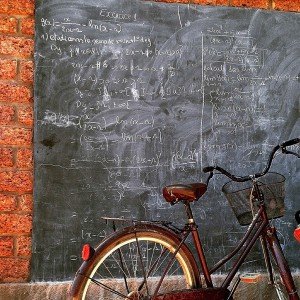
Any corner is perfecto to facilitate the studies of the children
Fulgence took it upon himself to write down the five items that we needed his advice, opinion or management of. As though it were a regular professional meeting, this fine man opined with real independence and took note of whatever he could help move forward for us. In particular, everything related to the possibility of starting a scholarship project for university students. It is much needed in the country and requires a lot of preparatory work to set up selection criteria, conditions of the rewards, work team, etc. He stayed for dinner, openly shared his opinion about what might happen in the upcoming presidential elections, and he went home with our heartfelt thanks.
The rest of the group then had quite a chat about the FAR’s strengths and weaknesses, and about the need to assure its future and make good its goal to continue its work.
I went up to my room tired but eager to write down such a rich day while it was fresh in my mind.
Monday, March 2
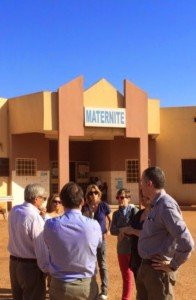
Public’s maternity entrance
The first day of work on the Maternity project, which I will summarize: the neighbourhood of Rimkieta, which is more or less the size of Barcelona – around 40 sq kms – barely has any maternity or pediatric care. There are in fact, two facilities 10 kms from the parish. One is a public maternity clinic that attends 700 births a year. It has scarce means and its physical site is terribly abandoned. The man in charge told us sadly that “women have stopped coming because we don’t have material to serve them. The birthing beds are horizontal, which is bad for the mother and for our work…” The other center is just a primary care facility, with no births attended. Like the other facility, what it does most is the so-called “family planning,” within the rubric of the main international organizations.
The Curé, the parish priest, who is a very large young man from Ghana, deeply apostolic and up to any task, works very hard attending the dozens of chapels and CBCs in which the Church’s function is organized. He never rests… Since he arrived, this curé has dreamed of a different kind of maternity facility that would operate within the criteria that the Catholic Church has always defended. It’s only natural. FAR, whose mission is to dignify the living conditions in the Rimkieta neighborhood and its surroundings, is a secular foundation that takes in anyone in dire need – there’s no shortage of such people there… But the Patrons are Catholic, and we like to collaborate with the Church because it is a trustworthy institution there.
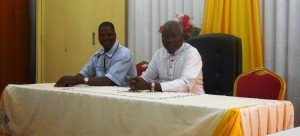
His eminence the Cardinal Archbishop Philippe Ouedraogo and the Curé Joseph Sambieni
So it is that when the Curé told us last year about the need for such a Maternity, we set to work to find money for its construction and equipment – around 45,000€. And we agreed that the monthly operating costs – which come to around 1,300€ – would be the parish’s responsibility and would entail a formal commitment from the archbishopric to sustain it. It was now time to formalize everything. We set three meetings for this purpose: one with the Curé himself – as a promoter; another with the Archbishop – as the guarantor of the Maternity’s sustainability; and another with the Parish Council – which was attended by a dozen of its 22 members, including its administrator. Setting terms for a commitment of this nature is quite complicated in these parts. It must proceed smoothly. But the level of detail and security that we require – so beneficial to all involved and essential for the donors – is foreign to the local mindset. This makes it quite hard work to reach agreements that one could defend to third parties. In any case, having undertaken the investment, the obligation to finance the operations and to sustain the facility over time was clear from day one, but has yet to be formalized.
The Maternity will be theoretically capable of attending 1,500 births, 9,000 gynecological visits and as many as 15,000 pediatric visits. But even if only half of that potential were realized, over the course of a few years the community would have been greatly served. But all of this is still to be seen, and the monthly costs the parish would have to assume are high. There, 1,300€ is a fortune – the monthly salary of some 30 people… a lot of money.
So Monday the 2nd, Tuesday the 3rd and Wednesday the 4th we devoted a lot of time to this new Project, almost a year after the Curé let us know that the World Health Organization (WHO) required a Maternity in order to not shut down the Health Center that we provided the parish 7 years ago. Surprizing that the WHO can intervene in a country in such a way.
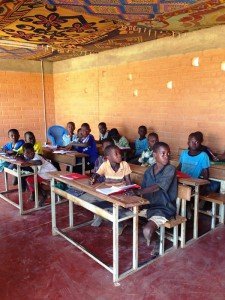
CIEPYD’s classroom with the 7th promotion children
We devoted the rest of the day to the educational, professional and sports reintegration center (CIEPYD in its Spanish acronym). This is what we call the project housed in a great building across from the Maternelle – designed and built by Catalan architect Albert Faus, who has lived there for years. Idrissa works at CIEPYD. He is responsible for the street kids project, which has enrolled 53 children in school, placed 26 children in vocational training and has 15 children in the first year of its own program. Jaques, Mady and Toe work with him. They are four giants in educating children whose difficult social and family circumstances have turned them into “problem” kids. Their work is hard to describe: Turning incorrigible kids, whose only concern for years has been to feed themselves at any cost, into civilized citizens. This great team manages to get these kids enrolled in school or in vocational training if they are not capable of studying. Deficient intellectual development is common there due to malnutrition in the early years of life. Starved of nutrients, the brain does not develop. That’s just how it is. And when you add a broken family to this, what can be expected? It seems nothing good might come of it… But the CIEPYD team tries to avoid this. The “sports” part of the program refers to the fact that there is a section for regular boys to come to the center top play sports, as a way to cultivate certain values. However we are rethinking this activity at the moment because parents in Burkina only want “Etós,” which is understandable. So we are trying to redesign the project along the lines of “stars with values”… we’ll see what comes of it.
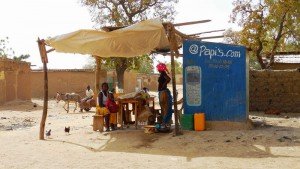
A kiosk in a Rimkieta’s street
At nightfall we saw our beloved La Salle Brother Salvador Ajangüiz. He’s been in Burkina for half a century and he keeps moving forward…with two schools and almost 2,000 students. He no longer teaches the students, but rather teaches the teachers. This is perseverance…Every time we come to Burkina we see him. We are grateful to him because his knowledge of the “terrain” helped us find our way. He didn’t tell us what to do, but he told us what not to do and he opened important doors for FAR. We talked a bit about everything. And he shared his view of the current political situation, pointing out four things. One of them the expelled president Compaoré and what he dubs the “extreme underground left,” to whom he attributes a relevant if not definitive role in next October’s elections. He told us that the popular revolution was a success for civilization. And that the previous opposition party and the newly rising MPP party should not underestimate the other two opponents. He’s a wise man. It certainly looks like Burkina will save itself from this one.
Tuesday, March 3
Cereal mill
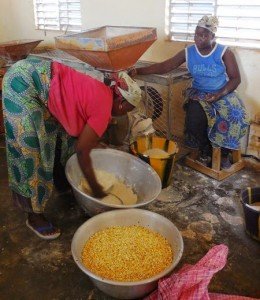
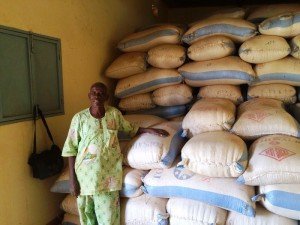
In addition to the meeting with his Eminence the Archbishop, to which I referred earlier, we visited the cereal mill, which does so much good, sparing thousands of hours of hand grinding of grain and of kilometers walked by so many women burdened by the weight of grain. We also visited – in particular Chus and Fernando with Xavi – the cyber, which as I mentioned is under a cost-benefit analysis at the moment. We also saw the cereal bank with Robert. It’s spotless. The last year it has been running at a minimum because the state put a cereal bank close by with “election campaign” prices, so our sales fell from a ton and a half weekly to two or three hundred kilos weekly. But what had to happen, did… The dictatorship ended and along with it the funding and that cereal bank closed. So since February we’ve been subsidizing more than a ton of corn weekly, which amounts to around 100,000 rations annually for the neediest. Robert is happy and so are we.
Robert with the corn’s stock of the cereals’ bank
We had both meetings with Sylvie and Colette. Sylvie (the mother of Flora, the little girl who is in some respect in FAR’s origins) is responsible for many projects like the wells, the cyber, the mill and others. She’s capable of just about any help that’s needed. Sylvie has been employed at FAR longer than anyone else, and a strong back up for Maria and Cristina when needed. Strong and loyal, she manages to make her personal and family life compatible with an intensive dedication to FAR. We spoke mostly about her education and training. She must continue learning. We also spoke with Colette, the accountant who also does bureaucratic tasks like going to the bank, and dealing with social security and the like. She’s a strapping young woman, mother of three, timid by nature. Just like we did with Sylvie, we encouraged her to continue her education. Colette wants to finish high school, which we support. This continuing education, which all 50 of the foundation’s employees have some plan for, isn’t too common in Burkina…
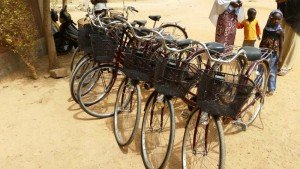
Next we handed over a dozen bicycles. The bicycle project is among the projects that most improve the quality of life of hundreds of people in Rimkieta.
Bicycles ready to be delivered
A bike in the West is a good of a sports and leisure kind. But there, at 40 degrees Celsius or more, a bike is the only means of transport for the poorest. A bike is a fortune because it puts one within reach of job possibilities, of one’s neighbors… and it facilitates any errand. It’s one thing to walk at 3 kilometers per hour in 40-degree temperatures and quite another to move from one place to another at the same temperature but at 12 kilometers per hour. The first is a hindrance to moving from one place to another. The second is a help. So giving a bike to one of those women, with her joyful expression, is a unique experience. They sign (with their fingerprint…) the papers and pay over the course of a year 30€, which is half of what the bikes cost us but almost a month’s base salary (currently around 45€), which many people don’t even earn…We have already subsidized 700 bikes, and have a waiting list for 500 more…
In the afternoon we went back to the Larlée Naaba’s house, as he wanted to honor us as usual with a private meeting. Visitors are offered water first thing. Other refreshments are offered later, but always water first. We chatted for almost 3 hours, half of which he dedicated to talking about moringa – a useful plant that he grows on a good portion of his 500 hectares to get oil and other products for skin and consumption. The plant has so many properties that it’s hard to understand why it isn’t more popular. Surprised, I looked into the topic on the Internet and was amazed. So when he offered to show us the installations the next day (13 kilometers and a half an hour away by car), I accepted. We saw the work being done on the palace to reconstruct the damage done by a mortar shell – which fortunately didn’t hurt anyone – during the days of his opposition to Compaoré. We saw his one-and-a-half-year-old twins, who of course burst into tears in the presence of so many “nasaara” (white people). And we said our goodbyes until 4 pm the following day.
We regrouped in the hotel, as the current security protocols recommend being in a safe place by nightfall, among other precautions. We went over the day’s events and off to bed. Well, in my case, to write, with the good news that the suitcases Fer and Javi checked in in Barcelona had arrived in Uaga. What luck!
Wednesday, March 4
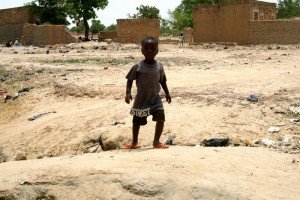
Off to Zongo! At 7:00 a.m. Zongo is a neighborhood, split off from Rimkieta by the only train track
A child hanging around in Zongo
in Burkina, which connects the capital Uagadugú with the sea in Abidjan, capital of Ivory Coast, some 800 kilometers away. Zongo is still being divided into lots and looks like Rimkieta did 10 years ago. According to its Naaba, it has around 15,000 inhabitants, and benefits from four wells that FAR recovered with the help of our Institutional Patron Company “Jeanología,” which is still committed to supporting FAR. Thanks to one of those wells, we managed to get a contract with the Naaba by which he ceded 1,500 square meters to FAR to create a vegetable garden in which some local women could work.
The garden, which was funded by the Netri Foundation, today provides a half day’s work (which is a
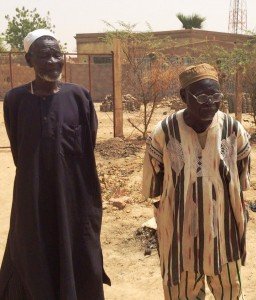
Zongo’s Naaba with one of his counselors
treasure there) to 23 women who have managed to achieve a yield that makes it sustainable. In the last trimester (December-February), those women earned a yield of 600€ that they divided amongst themselves. That works out to almost 10€ a month for half a day’s work, which is a fortune for people who have never earned anything, and an encouragement for those who have never had any kind of recognition before. Those women are delighted. And they have asked us to mechanize part of the process of extracting and transporting water. We’re working on it… It moves me to think that only three years ago we were told that everything should be manual and now we are looking into the possibility of moving towards mechanization – at their behest!! Everything is like that there – slow, gradual, progressive… Anyone who doesn’t have a lot of patience should stay away and leave it to the rest of us…
The Zongó Naaba came by to greet us at the garden before we were scheduled to pay him a visit.
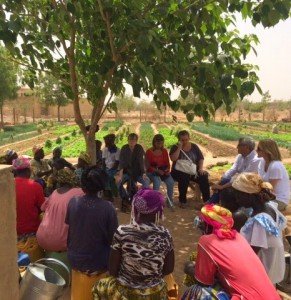
Meeting with the women, the garden at the back
That’s quite a gesture in those parts, and an honor for us. We said hello and he immediately told me “the papaya trees need more water…” 8 months ago we planted 50 papaya trees, only half of which are progressing well. There are already some bearing fruit, but some are growing slowly, some are male and don’t bear fruit, and yet others were knocked over by strong winds. After rallying our beloved gardeners (Valerie, the garden’s “boss, translated to and from Moré), and even dancing with them, we headed off for the Naaba’s “palace,” accompanied by the group in song. The head of the project told me expressly that the women are happy and learn from that basic agriculture. It was beautiful to receive so many thanks. We left with a much better taste in our mouth than we’d ever taken from Zongo before. Due in grand measure to the labors of Cristina, who oversees Valerie week-in, week-out, to everyone along the line who teaches skills, to the women themselves, and to “what just happens,” as there something always happens….
At 4 in the afternoon, at a mere 35 degrees Celsius, we went to meet up with the Larlée Naaba at his house, where he happened to be conversing with M. Roc, who is considered to be the country’s next presidente.
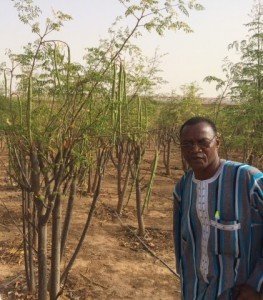
The Larlé Naaba in the plantation
He’s a huge man, son of a banker and himself a former banker, and was educated in Europe. We greeted him and I was introduced to him as Professor “Velázquez,” which the whole group made fun of me for the entire trip. What a bunch of kidders!!! We set off in three cars. I was in his van, scrunched in the back with my knee in not too good a position. There we saw half a hectare of moringa by way of example, and had its many benefits explained to us. We also saw the facilities where different products are distilled from the plant, as well as the biodiesel plant that was financed by the Taiwanese government. And some chickens…examples of his theory that four chickens and two roosters can raise a family out of poverty. As far as I was able to understand, the State has done this for 130,000 families. After giving us some beautiful traditional suits and some tablecloths for the women – his usual gifts for his guests – we said our goodbyes and hurried off, as Fernando and Javi were to fly home at night. Hotel, chat, goodbyes for the travellers, and dinner.
Thursday, March 5
Our last day! We devoted it entirely to the team.
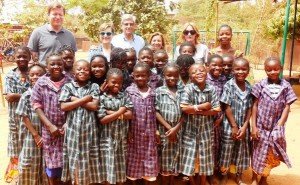
Third promotion of the “unschooled girls projet”
First Rihanata, the Maternelle’s headmistress, and her assistant, Mme. Hema – who has only been with us a year-and-a-half but whose progress is very promising. As always, we tried to thank them for their work and to encourage them to aim high. Especially with regard to Mme. Hema’s fantastic work with the Unschooled Girls Project, which his subsidized by the Foundation Women for Africa. We visited them afterwards and they moved us greatly once again. What joy! What smiles! These girls have something special that only they have.
Then we thanked the outgoing team of delegates for the personnel for having had the guts to take up FAR’s new challenge, and we encouraged them to give their support to the new representatives.
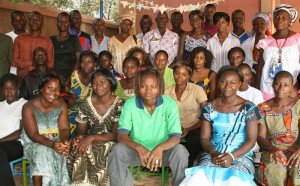
Part of 50 people of the FAR’s team in Rimkieta
The meeting with the four new representatives centered on thanking them for their generosity and courage (there this kind of responsibility is less than appetizing), and on explaining their dual role transmitting information from the workers to the managers and vice versa, especially any potential problems or needs we should know about. I asked them for loyalty and transparency. And I proposed three “wishes” to strive for: trying to do everything –grand or small – to the best of their ability by taking care of details so that FAR continues to be an example of the new Burkina that all of us desire; continuing the training of all the employees in order to better serve others; and true solidarity, which is giving to those in need without expecting anything in exchange – a concept somewhat foreign in those parts. I explained to them that the FAR employees’ “donation box” collects a monthly average of 1.5€, and monthly salaries add up to more than 3,000€. I told them that our European sponsors – mostly Spanish – are living through a financial crisis, yet donate between 20 and 30€ each month. There the average base salary is around 45€ per month, but our entire workforce earns between two and five times that. Our base salary is 20 times that…yet they donate an average of 3 cents each (it’s anonymous – so each can decide for himself) while every sponsor donates 20€…or 700 times more…Being as they are the privileged who have jobs – in FAR no less – salaries, social security, training…they should understand that it’s not unreasonable for me to have to hear frequently “What are you doing there in Burkina, or whatever it’s called (many people don’t know a thing about that country, not even its location) with all that’s happening here?” Jacques was moved. And all four said they would help in any way possible.
And to conclude, the same speech to the entire workforce, who listened respectfully and serenely. Final thanks. Applause and goodbyes, practically one by one.
Finally, we had lunch at the hotel, did a final round-up of the week, bought karate and other little things for our families and friends – as always an amusing confusion; a bit of rest; my final meeting with Cristina to give her my deepest thanks – she worked hard and rested little; an ice cream and off to the airport with my son-in-law Patrick and his good friend and colleague Valea. Their help with airport red tape is like the work that guardian angles do….
Thank God, Fer and Javi had arrived safe and sound in Barcelona that very morning. Everything perfect on our end as well: Chus to Madrid, Valery to Basilea via Amsterdam (quite comfortable…), and Eva, Carme and I to Barcelona.