
I’m back in Rimkieta after a few weeks in Barcelona. I’ve come back refreshed, and full of energy. And I’m convinced that after what this country has suffered over the past two years (the threat of Ebola, a popular uprising and the president stepping down, a year of transition government, an attempted coup d’état, a terrorist attack, a raid on an arms depot, fires…), now more than ever we must continue in Rimkieta – faithful to our maxim to keep up more than to take up.
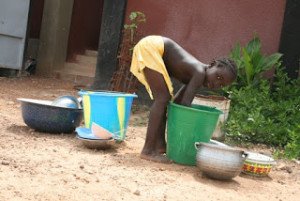
To clean the clothes and the plates, one of the responsibilities of an orphan girl living in a “taking in” family
And the thing is, it’s our role here to facilitate development in the long term. We aren’t in a hurry. And to do that, we have to be here, and what’s more: to be here for many years, trying to do what we do as well as possible.
It’s not “just” a matter of providing material goods (food, medical care, scholarships, bicycles, trees, etc.). We also try to stimulate change in the society, while always respecting its traditions and cultures.
Daily events remind how far this society has yet to advance.
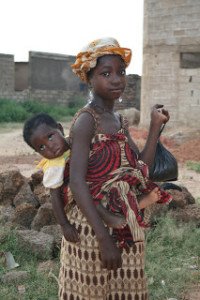
Another responsability: to take care of babys
Among these is the case of K. Sadia, one of the girls in the “unschooled girls” program. She’s one of those girls without a birthday. They know the year – 2006 – but neither the day nor the month. Sadia’s mother abandoned her when she was 4 years old and her father went to live in Ivory Coast, leaving her in her widowed grandmother’s care. Being “taken in,” although in a family member’s house, Sadia had to take care of the housework from a young age, until she entered the FAR project. Schooling the girls in the project is important, but so is managing to convince the families that take them in to relieve them of their household duties so that they can study and play, as befits girls of this age.
One day Sadia came to class with a cut on her cheek. We asked how she’d done it. Her grandmother had hit her with the cable of a cell phone charger… We called the grandmother to give us her version of the event and she confirmed that, in fact, that was what had happened. The cause: Sadia had asked permission to play with her friends, but her grandmother hadn’t let her because she had to stay home to wash clothes. They got entangled in an argument and the grandmother wound up hitting her with the phone charger. The grandmother acted sorry and promised not to do it again. But hitting children – and when I say “hit” I am not referring to a “smack,” but rather to real hitting with the intention of humiliating – is normal here. Not only at home, but also – and even more – in schools. Every year we have girls and boys in our projects who have wanted to abandon school because of constant beatings from their teachers, or who have left home – especially boys – for the same reason. Violence only creates fear in a child and it cannot be a method of discipline because it doesn’t help children reflect on what they have done wrong.
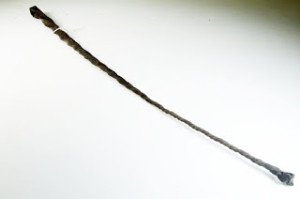
One “chicotte”
Hitting children is so commonplace here that one of the teachers we had in our unschooled girls project brought a cork “chicotte” (https://fr.wikipedia.org/wiki/Chicotte) with her in plain sight among her other materials- pens, textbooks and notebooks… I’m not quite sure why, but I have it here, in a drawer in my office. Perhaps so that every time I open it, I am reminded of how far we have to go and how important it is “to keep up more than to take up.” Because to teach them to fish, it is not enough to give them a fishing rod, but rather we have to fish side by side for many years. That’s what we are doing, thanks to all of you who support us, economically, spiritually and with your affection.