
Blog
< Back
Orphans of Living Parents
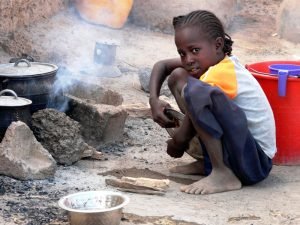
An unschooled girl cooking for the whole family.
There are numerous posts in which we describe the difficult living conditions of the girls we affectionately call “Cinderellas,” because we believe that they inspired Charles Perrault’s famous 1697 story that became the 1950 Walt Disney film. “Cinderella was poor, had no parents and lived with her stepmother, a widowed woman, very cantankerous, who was always angry and shouting orders to everyone.”
The lives of these girls could inspire a post every day. Such is the case of Sadia and Bintou, two sisters (13 and 15) who have been left totally helpless after their yaaba (“grandmother” in Mooré, the language of Burkina’s majority ethnic group: the Moosi) suffered an accident.
Sadia and Bintou were abandoned by their parents when they were 3 and 5 years old, respectively. The parents were separated by a fight within the “grande famille” (the term for the vast consanguineous family clan, close or not, which in Burkina has an enormous influence on the life of couples/marriages).
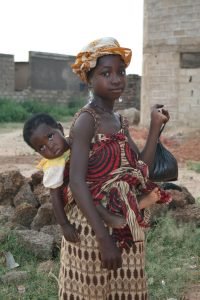
Girl in charge of a baby, a common scene in Rimkieta
A few months after the separation, the mother found a new husband who did not admit the girls, so she left them with the father. The father, in turn, found another woman, who also refused to accept him with the girls, so he left them with his own mother. When it rains, it pours.
During the ten years since their abandonment, left in charge of their yaaba, they have not seen their father or mother even once. During the first years, they occasionally got a call from one or the other showing “interest in them.” But, for more than four years now, not even that.
Yaaba has done everything she could during these years in charge of the two girls, and has ensured that they’ve never gone hungry. But, people of the grandmother’s generation can barely understand their own feelings, much less understand and worry about those of the girls, who hid away in resignation so much pain in a corner of their heart.
Yaaba had an accident and broke her leg. She suffered a head-on collision with a motorcycle while pedaling her bike to the market to sell condiments (salt, garlic, parsley, onion) – the job that allowed her to provide for her granddaughters. As a last resort to find help while she is disabled, Yaaba called the girls’ parents. The fact that both parents have ignored the problem has opened a Pandora’s box of feelings for both girls, who have been plunged into a spiral of frustration, pain and anger.
Thank God that our dear Brigitte, the psychiatrist, is already working with them to help them to understand those feelings and to put them in their place. Of course, when necessary in specific cases like this one, FAR will provide extra help. Until yaaba’s complete recovery, all three will be assured of at least a meal a day.
Sadly, the case of Sadia and Bintou is not exceptional. Rather, though sometimes at lesser degrees of abandonment, it is quite common to many of the beneficiaries of our projects.
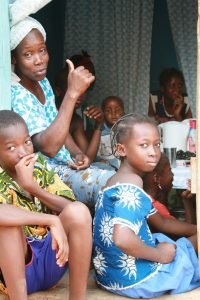
Yaaba with several dependent grandchildren
Without judging what can lead a mother to abandon her children – which in my privileged reality it is something inconceivable – we must bear in mind that the enormous and countless basic needs that these mothers fight for daily can push them to it. I won’t even mention the father, due to the secondary role that, unfortunately, fathers play in Burkinabé society
From carrying our surveys of the personal situation of FAR beneficiaries, we are familiar with the recurrent themes behind cases of abandonment. The two most common scenarios are: the mother remarries and the new husband does not want to take care of the children she had with her first husband; or the father remarries and fears that the new wife will not take care of his children as she should, prioritizing her own.
In both situations, the children will be abandoned – not necessarily together in the case of siblings (in this sense Sadia and Bintou are “privileged”) – in the homes of relatives (usually the grandmother) or of family acquaintances.
This socially accepted practice generates family nuclei that are not formed by direct relatives. Most families are made up by 75% of individuals from the consanguineous family nucleus, 20% close relatives, and 5% with no blood correlation.
Marie, abandoned by both parents at a neighbor’s house and working as “Cinderella” since she was six years old, today is finishing her third year of sewing training. Ibrahim, who was left motherless and whom his father abandoned with a maternal aunt in order to remarry, was rescued from the dangers of the street, and today is one of the top of his class at school.
Maimounata, Oumou, Nemata, Aziz, Charles… all of them orphaned children of living parents, children made of sturdier stuff, who today have better life options thanks to the accompaniment and support of all those who make it possible, and especially of the “la Caixa” Foundation (1). Let’s keep it up!
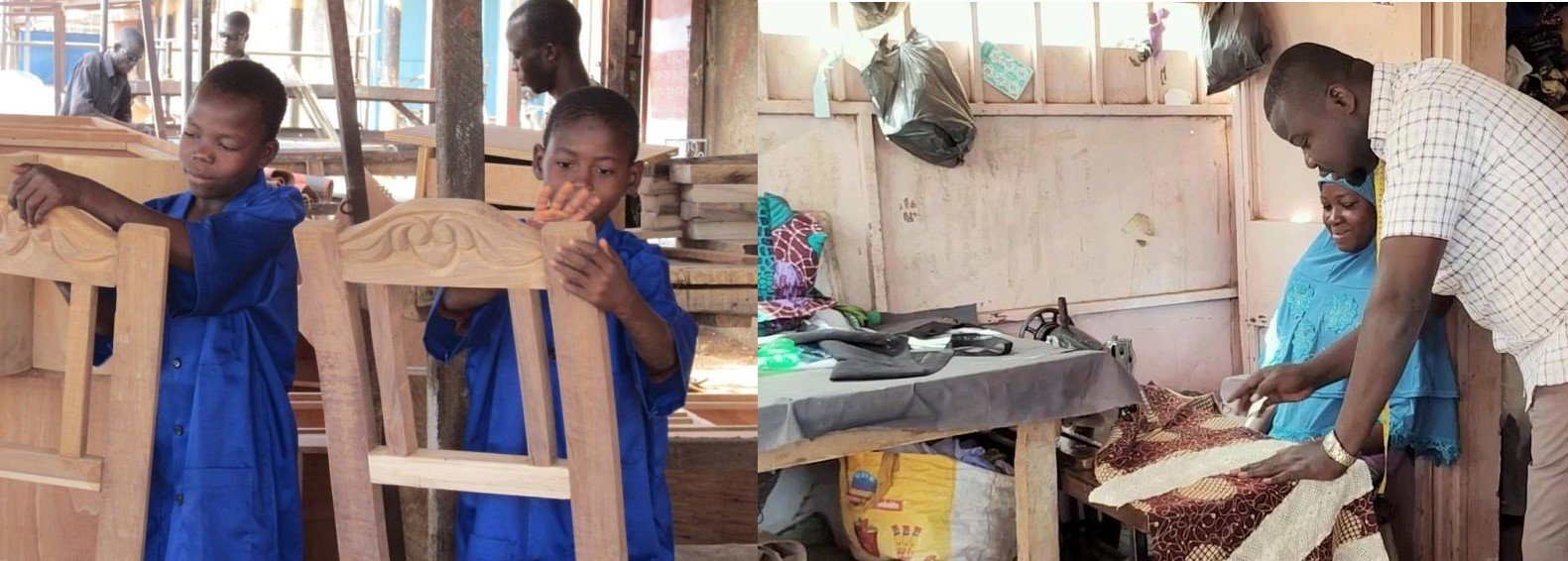
FAR professional training for girls and boys in workshops
(1) #FundaciónlaCaixa #HubSocial #ConvocatoriasFundaciónlaCaixa this year collaborates with the FAR in the “Education for Unschooled Girls” and “Training and Reintegration of Street Children” projects.